




Building the Decision Support System for simulating Circular Economy interventions

RA4 is the "Simulating" phase where the analytical engine developed in RA3 is translated into a functional, spreadsheet-based Decision Support System (DSS). This final activity operationalizes all prior research, creating a tool that is both scientifically grounded and practically accessible for policymakers, local administrators, and stakeholders. The DSS (H-SMA-CE) enables users to estimate costs, benefits, and impacts of CE interventions in Historical Small Towns. It provides an interactive calculation instrument for simulating impacts and communicating results for a more focused and widespread culture of Circular Economy at HST level.
Duration: Year 2 — First and Second Semester; Year 3 - January and February
Status: Almost Completed
Lead: RU2 — University of Naples "L'Orientale"
Development of a computer spreadsheet-based DSS (Excel with VBA) able to estimate costs, benefits, and impacts of CE interventions in other HSTs.
Testing the system with selected measuring actions to evaluate effects in terms of circularity indicators on the Taurasi case study.
The H-SMA-CE DSS was developed as a spreadsheet-based tool using Microsoft Excel with VBA macros for automation and interactivity. The system architecture comprises multiple integrated modules: a Home Dashboard providing navigation and visualization of circularity assessment results; a Calibration Module for data entry covering territorial characteristics, demographic data, waste flows, and economic indicators; a What-If Simulation module enabling scenario testing with different intervention portfolios and budget constraints; and an Optimal Strategy Finder applying multi-criteria optimization to identify intervention portfolios maximizing environmental, social, or economic objectives. The tool translates the methodological framework from RA3 into a practical instrument accessible to policymakers and local administrators without specialized technical expertise, while maintaining scientific rigor in its analytical capabilities.
The DSS was tested and validated using the Municipality of Taurasi as a representative HST. The validation process involved applying the complete analytical workflow to real municipal data collected during RA1, computing the MCEI and domain scores for the period 2018-2022, and simulating various CE intervention scenarios identified in RA2. Testing demonstrated the system's capability to accurately calculate composite indicators, perform what-if analyses for policy planning, and generate optimal intervention portfolios under different objective functions (economic, environmental, social). The validation confirmed both the technical reliability of the DSS calculations and its practical utility for supporting evidence-based decision-making in HST contexts.
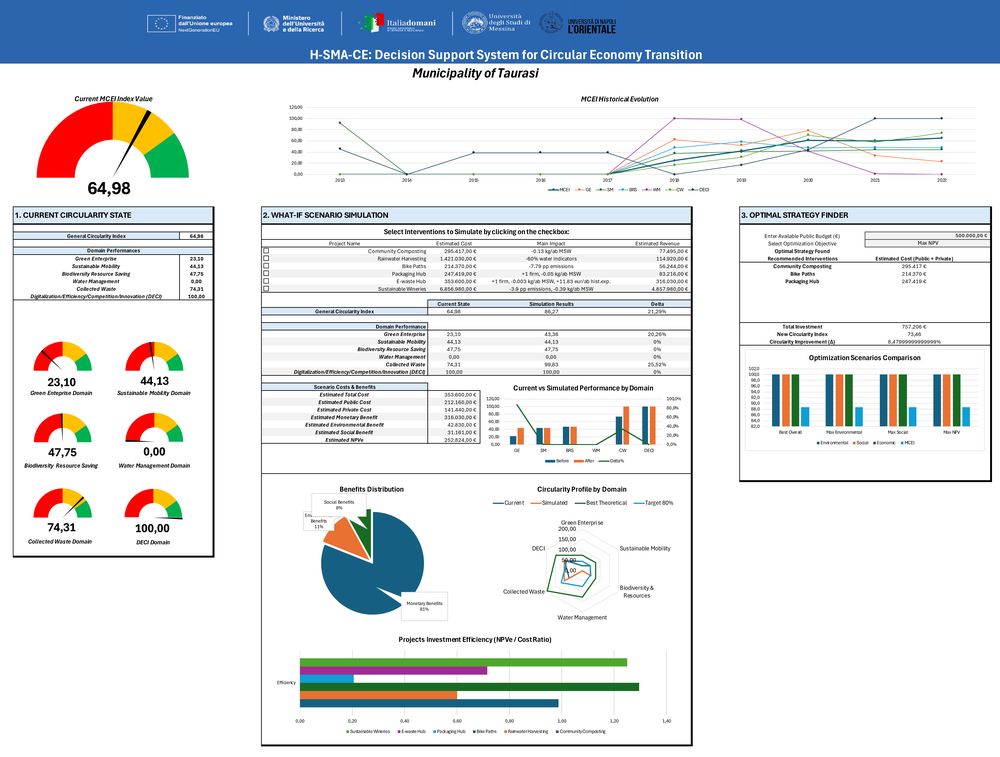
Experience the DSS developed through this research activity with Taurasi case study data pre-loaded.
Access DSS Demo →